
About
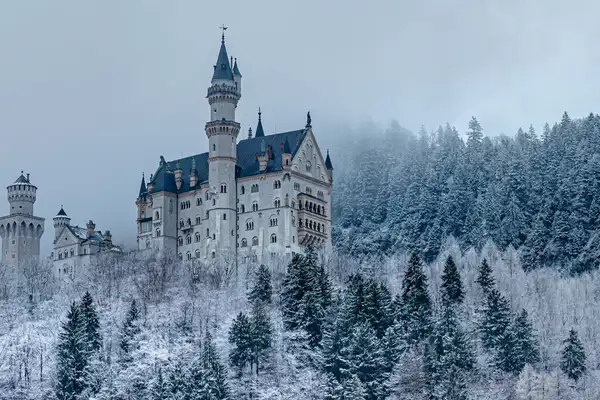
Neuschwanstein Castle rises from a jagged limestone ridge above the Pollat Gorge in the Bavarian Alps like a fever dream rendered in stone and turret. Commissioned by King Ludwig II of Bavaria in 1869 and never fully completed before his mysterious death in 1886, the castle is the most visited palace in Germany, drawing nearly 1.4 million visitors each year to stand beneath its white limestone walls and wonder at the mind that conceived it. It is not a medieval fortress and was never intended to be one. Neuschwanstein is a 19th-century stage set built with modern engineering — steel frame hidden beneath Romanesque arches, central heating concealed behind Byzantine murals, a telephone installed in the king's study — all in service of a single man's obsession with the mythological past. Ludwig II was twenty-three years old when he laid the foundation stone. He had been king since the age of eighteen, a shy and intensely private young man who found the realities of governance — the Prussian wars, the political machinations of his ministers, the Bavarian parliament's tedious debates — unbearable. His true passions were Richard Wagner's operas and the medieval legends they dramatized: Lohengrin the Swan Knight, Tannhauser the cursed minnesinger, Parsifal and the Holy Grail. Ludwig had already become Wagner's most extravagant patron, funding the composer's debts and building the Bayreuth Festspielhaus. Now he would build a castle that was itself an opera — a three-dimensional Gesamtkunstwerk, a total work of art, where every room told a different legend and the Alps themselves served as backdrop. The Throne Room, modeled on the Hagia Sophia in Constantinople, soars two stories beneath a blue ceiling painted with stars and a massive golden chandelier weighing nearly a ton. The Singers' Hall, inspired by the legendary contest of minnesingers at the Wartburg, stretches the entire fourth floor of the castle and is adorned with murals depicting scenes from Parsifal and the Grail legend. The king's bedroom took fourteen woodcarvers four and a half years to complete its elaborate Gothic canopy bed, every surface alive with carved oak tracery depicting scenes from Tristan and Isolde. Yet Ludwig spent only 172 nights in his castle. On June 10, 1886, a government commission arrived and declared him insane — a diagnosis made without ever examining him. Two days later, Ludwig and his physician Dr. Bernhard von Gudden were found dead in the shallow waters of Lake Starnberg under circumstances that have never been satisfactorily explained. The castle he built to escape the world became, within weeks of his death, the very thing he would have despised: a public spectacle, opened to paying tourists to help settle his massive debts. Today Neuschwanstein is Germany's most photographed building, the inspiration for the Disney castle logo, and an enduring monument to the collision between artistic vision and political reality. Ludwig wanted a private sanctuary for his dreams. The world turned it into a postcard.
Historical Significance
“Neuschwanstein Castle represents the pinnacle of 19th-century Romantic historicism — the movement that sought to reimagine the medieval past through modern eyes and modern technology. Unlike genuine medieval castles, which evolved organically over centuries in response to military need, Neuschwanstein was designed from the outset as a theatrical composition, a building intended to look like a medieval castle while incorporating every modern comfort available in the 1870s and 1880s: forced-air heating, running water on every floor, flush toilets, electric call bells for servants, and even a telephone connected to a switchboard in Munich. The castle was designed not by an architect but by a theatrical set designer. Christian Jank, the scenic artist for the Royal Court Theatre in Munich, produced the initial watercolor sketches that defined the castle's silhouette — the soaring towers, the dramatic perch above the gorge, the fairy-tale profile against the Alpine backdrop. Only then were the architects Eduard Riedel and later Georg von Dollmann brought in to translate Jank's stage-set visions into buildable structures, a process that required ingenious engineering solutions including a steel-frame skeleton concealed within the Romanesque walls. Ludwig intended Neuschwanstein as one element of a trilogy of fantasy palaces. Linderhof, completed in 1878, reimagined Versailles as an intimate Rococo jewel box. Herrenchiemsee, begun in 1878 on an island in the Chiemsee, was a near-exact replica of the central section of Versailles. Neuschwanstein was the medieval fantasy — together the three castles represented Ludwig's attempt to construct an alternative reality in stone, a private world of beauty and legend where the ugly realities of Bismarck's Germany could not reach him. The castle was never finished. When Ludwig was deposed and died in 1886, the Throne Room lacked its planned mosaic floor and the throne itself was never installed. Several rooms on the upper floors were left as bare brick. The irony is staggering: the castle built as a private retreat was opened to the public just seven weeks after Ludwig's death, and the admission fees helped pay off his debts. It has been open continuously ever since, visited by over 60 million people.”
Stories
3History
👑 Built by
King Ludwig II of Bavaria; architects Eduard Riedel, Georg von Dollmann, Julius Hofmann
1868 - Ludwig II writes to Richard Wagner describing his vision for a "new Hohenschwangau Castle" in Romanesque style
1869 - September 5: foundation stone laid after the old ruins on the ridge are blasted away
1873 - Gatehouse completed; Ludwig begins living there while the main castle is under construction
1880 - Palas (main building) topped out; interior decoration begins
1884 - Ludwig moves into the incomplete castle, occupying the royal apartments on the 4th floor
1886 - June 10: Government commission arrives to depose Ludwig; he is declared insane
1886 - June 13: Ludwig and Dr. Gudden found dead in Lake Starnberg
1886 - August 1: Castle opened to paying public, just 7 weeks after Ludwig's death
1923 - Nazi party briefly considers using Neuschwanstein as a party headquarters
1944-1945 - Used by Nazis to store looted art from France; recovered by Allied Monuments Men
1955 - Walt Disney visits and is inspired for Sleeping Beauty Castle at Disneyland
2007 - Finalist in the "New Seven Wonders of the World" campaign
2015 - Nominated for UNESCO World Heritage status as part of "Ludwig II castles" application