
About
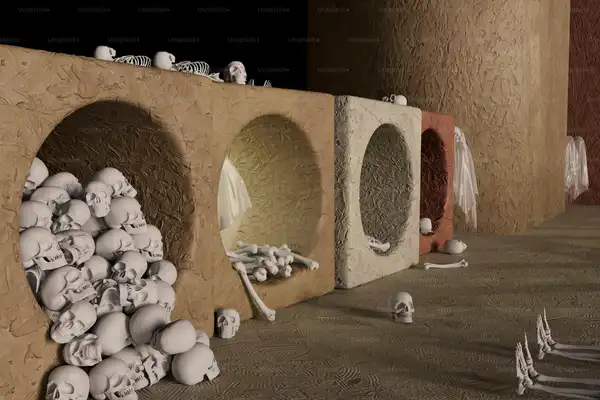
Beneath the streets of Paris lies a second city — a vast network of underground quarries, tunnels, and galleries stretching over 300 kilometers under the Left Bank, carved out over centuries to provide the limestone that built Paris above. In 1786, a portion of this subterranean labyrinth was consecrated as an ossuary, and the bones of approximately six million Parisians were transferred here from the city's overflowing cemeteries, creating what would become known as the Empire of the Dead. The Catacombs of Paris are not true catacombs in the Roman sense — they were never intended as burial places. They are repurposed quarries, the hollowed-out remnants of limestone extraction that began in the Gallo-Roman period and continued through the Middle Ages. By the 18th century, the quarries had become a problem: the city above was sinking. In 1774, a section of the Rue d'Enfer (Street of Hell) collapsed into the void below, swallowing houses and their inhabitants. The Inspection Générale des Carrières was created to map and stabilize the tunnels. Simultaneously, Paris faced a public health crisis above ground. The Cimetière des Innocents — the oldest and largest cemetery in Paris, used continuously for over a thousand years — had become an open horror. Bodies were buried in mass graves 10 meters deep. Decomposition gases burst through basement walls of neighboring houses. In 1780, a cellar wall collapsed under the weight of a mass grave, flooding the basement with corpses and putrid soil. The cemetery was condemned. The solution was grimly elegant: move the dead underground. Beginning in 1786, under the supervision of Louis-Étienne Héricart de Thury, the bones were exhumed from the Innocents and dozens of other cemeteries and transported through the streets of Paris in black-draped carts, accompanied by priests chanting the Office of the Dead, always at night. The bones were then arranged in the quarries — not merely dumped, but organized into decorative patterns: walls of femurs and tibias punctuated by rows of skulls, archways of bones, crosses and hearts made of skeletal remains. The result is macabre art — death transformed into architecture. Today, approximately 1.5 kilometers of the ossuary are open to the public, but the full network of quarries extends over 300 kilometers — a shadowy, unmapped underworld that has fascinated explorers, artists, and trespassers for over two centuries.
Historical Significance
“The Catacombs of Paris represent one of the most extraordinary solutions to an urban crisis in history — the wholesale relocation of millions of dead from overflowing cemeteries to repurposed quarries beneath the city. The project reflects both the Enlightenment's rational approach to public health and a deeply French aesthetic impulse: the bones were not merely stored but arranged into decorative patterns, transforming a sanitation project into an artwork of death. The ossuary also represents the democratic nature of death in a uniquely Parisian way. The bones of the poor and the powerful are mixed together indiscriminately: aristocrats and peasants, saints and criminals, victims of plague and revolution alike share the same walls of carefully stacked remains. Among the six million sets of remains are those of figures from every era of Parisian history: medieval serfs, Renaissance artisans, Revolutionary victims — possibly including bodies from the September Massacres of 1792 and the Terror of 1793–1794. The broader quarry network has its own significance as a parallel geography of Paris. During World War II, the French Resistance used the tunnels as headquarters, while the Germans built a bunker below the Lycée Montaigne. The quarries have served as mushroom farms, beer cellars, and — in the 21st century — the site of secret underground parties and an unauthorized cinema discovered by police in 2004.”
Geschichten
2History
👑 Built by
Louis-Étienne Héricart de Thury (ossuary design); Charles-Axel Guillaumot (quarry inspector general)
12th century onward - Limestone quarrying beneath the Left Bank provides building stone for Paris
1774 - Section of the Rue d'Enfer collapses into quarry void; houses swallowed
1777 - Inspection Générale des Carrières created to map and stabilize the underground tunnels
1780 - Cellar wall on Rue de la Lingerie collapses under weight of mass grave from the Cimetière des Innocents
1786 - April 7: Cimetière des Innocents condemned; bone transfer to quarries begins, with nightly processions of black-draped carts
1786-1788 - Bones from the Innocents transferred; arrangement of bones into decorative patterns begins
1787 - Bones begin arriving from other condemned cemeteries across Paris
1793 - Philibert Aspairt, doorkeeper of the Val-de-Grâce hospital, disappears into the tunnels; his body found 11 years later
1810 - Héricart de Thury redesigns the ossuary as a visitable monument, adding inscriptions and philosophical quotations
1859 - Last major transfer of bones to the ossuary, from cemeteries displaced by Haussmann's renovation of Paris
1867 - Napoleon III hosts a reception in the Catacombs during the Universal Exposition
1944 - French Resistance uses the tunnels as a command post; Germans build a bunker in the quarries below the Lycée Montaigne
2004 - Police discover an unauthorized cinema, complete with screen, seats, and bar, in a quarry chamber
2017 - Extensive renovation of the public ossuary section completed